
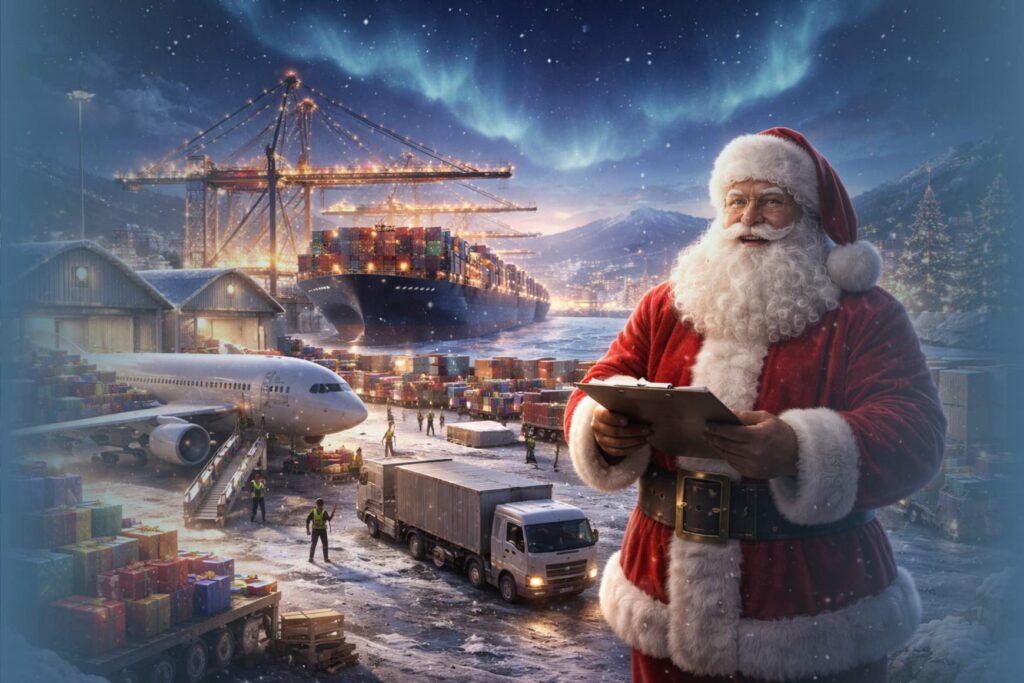
Introduction
Christmas is often associated with magic. However, from a logistics perspective, it represents one of the most complex delivery operations imaginable.
If Santa Claus treated Christmas night as a real transport project, he would manage a large-scale, time-critical international shipment with zero tolerance for delay.
Therefore, this article explores how Christmas logistics operations would work when handled as a real peak-season transport project.
Project Scope and Transport Requirements
A large-scale Christmas delivery operation includes several operational challenges.
First of all, it requires global geographic coverage.
In addition, it involves strict delivery deadlines with no flexibility.
Moreover, the cargo mix includes fragile, oversized, and time-sensitive goods.
At the same time, deliveries must take place across multiple regions within a very limited execution window.
As a result, this type of seasonal transport is not a miracle, but a carefully structured logistics process.
Route Planning and Time Management
For a project of this scale, route planning plays a central role in on-time delivery.
Each delivery zone needs predefined routing. Therefore, planners must consider:
distance and transit times
seasonal weather conditions
traffic and operational restrictions
contingency routes in case disruptions occur
Consequently, for time-critical holiday shipments, teams must complete planning long before execution begins.
Multimodal Transport Structure
A single transport mode cannot meet such tight deadlines.
For this reason, international holiday deliveries rely on multimodal transport solutions.
A realistic setup includes:
air transport for intercontinental movements
road transport for regional and last-mile distribution
consolidated cargo handling to optimise capacity and time
As a result, multimodal coordination allows complex deliveries to remain efficient under peak-season pressure.
Coordination and Operational Control
During execution, continuous operational coordination becomes essential.
Clear communication, real-time monitoring, and fast decision-making actively prevent small issues from turning into critical delays.
Moreover, during the holiday peak season, operational control often matters more than transport speed alone.
Risk Management During the Peak Season
Christmas represents the ultimate stress test for supply chains.
Therefore, risk management becomes a core element of seasonal transport planning.
Key risk factors include:
limited capacity
high shipment volumes
non-negotiable deadlines
To mitigate these risks, logistics teams define alternatives in advance, assign clear responsibilities, and align expectations between all parties involved.
Key Logistics Lessons from Christmas
The reason Santa’s delivery stays on schedule is simple: everything is planned before the journey begins.
Reliable logistics does not rely on improvisation.
Instead, it depends on preparation, coordination, and accountability — especially when deadlines cannot move.
Ultimately, Christmas reminds us that strong supply chains are built before the busiest night of the year.
If you want to explore more about our logistics services, you can visit our Service page:
https://ictl-belgium.com/services/