
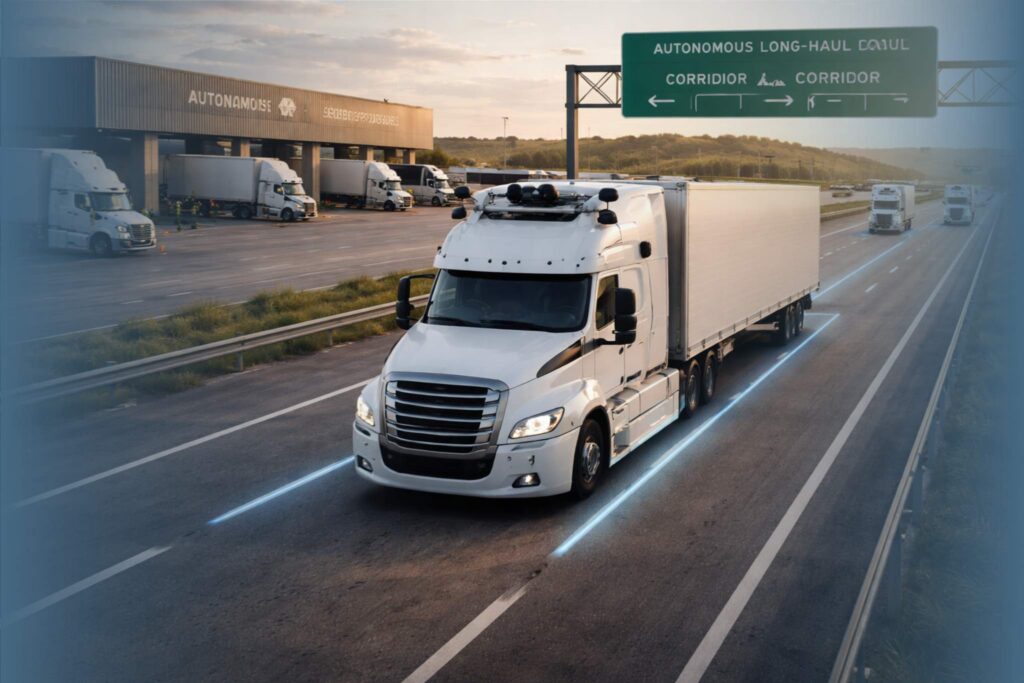
Autonomous Trucks in Logistics: What’s Changing Right Now
Autonomous trucks are quickly moving from concept to reality. What used to be limited to pilot projects is now entering real logistics operations, especially in controlled long-haul environments.
For the logistics industry, this is not just about technology. It is about how transport networks will be structured in the coming years — with more automation, higher efficiency, and new operational models.
What are autonomous trucks?
Autonomous trucks are freight vehicles equipped with sensors, AI systems, and advanced software that allow them to operate with reduced human input.
In practice, the most relevant use case today is hub-to-hub transport on highways, not full end-to-end automation. This means:
- First mile → handled by a human driver
- Long-haul → handled autonomously
- Last mile → handled by a human driver
This hybrid model is currently the most realistic and scalable approach.
Why is this becoming important in logistics?
Several factors are driving the shift toward autonomous trucking.
1. Driver shortages
The logistics industry continues to face a structural lack of drivers, especially for long-distance routes.
2. Pressure on efficiency
Companies are looking for ways to optimize costs, improve delivery predictability, and increase asset utilization.
3. Technology maturity
Autonomous systems are no longer experimental — they are being tested and gradually integrated into real operations.
Key benefits for logistics
More efficient operations
Autonomous trucks can operate for longer periods with fewer interruptions, improving fleet productivity.
More predictable transport
Highway routes are structured and repetitive, making them ideal for stable and reliable freight flows.
Better network planning
Autonomy enables new logistics models, especially hub-to-hub systems with optimized transfer points.
Safety potential
Automation reduces human-related risks in long-haul driving, although strict safety frameworks remain essential.
Where does the market stand today?
Autonomous trucking is already being tested and partially implemented, but it is still in an early stage.
Adoption is happening gradually:
- First in controlled environments
- Then on selected routes
- Eventually scaling across wider networks
In Europe, development is slower due to regulatory complexity, but progress is ongoing.
What are the main challenges?
Despite the progress, several barriers remain:
- Regulation and legal frameworks
- Infrastructure readiness
- Integration with existing logistics systems
- Public acceptance and trust
Autonomous trucking works best in defined conditions, which means it cannot yet replace all transport scenarios.
What does this mean for logistics companies?
The key question is not if autonomous trucks will be used, but where they create value first.
The most relevant areas include:
- Long-haul repetitive routes
- Hub-to-hub transport models
- Dedicated freight corridors
Companies that start understanding these use cases now will be better prepared for future adoption.
Final thoughts
Autonomous trucks are not replacing logistics overnight.
But they are already changing how the industry thinks about transport.
The shift is subtle but important:
from traditional point-to-point delivery → to optimized, structured, and partially automated networks.
For logistics companies, this is less about technology itself – and more about how operations will be redesigned around it.
If you would like to learn more about our logistics services, please visit our Services page:
https://ictl-belgium.com/services/